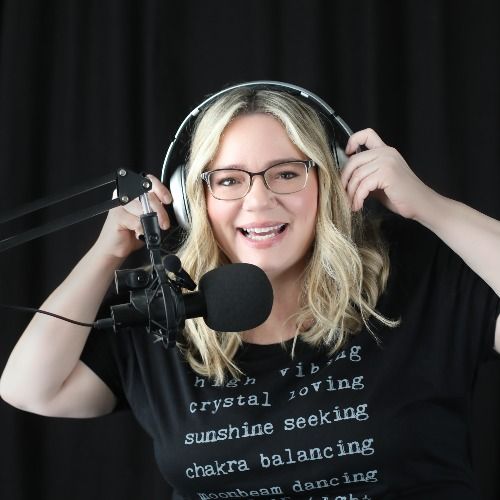
Episode 60
060: Why Repeating Yourself on Your Podcast Is Actually a Growth Strategy
Ever caught yourself thinking, "Ugh, I already talked about this" — and then talked yourself out of recording an episode because of it?
Yeah. Me too. And I'm here to tell you: stop doing that.
In this episode, I'm bringing you something I learned on a tour in Atlanta (yes, really — we were visiting Stranger Things filming locations with my 15-year-old niece, and I got a podcast lesson out of it). It's called Second Screen Syndrome, and once you understand it, you'll never feel guilty about repeating yourself again.
Here's the thing: podcasting has always been a secondary medium. Your listeners are doing the dishes, walking the dog, driving, folding laundry — and that means they're probably only half-listening. Which means they need to hear your best stuff more than once.
In this episode we talk about:
- What Second Screen Syndrome is and why Netflix is literally creating content around it
- Why podcasting has always been a secondary medium — and what that means for your content strategy
- Why repeating your most important teachings is not lazy, it's actually serving your listeners
- How to revisit a topic with a fresh angle, a new story, or a seasonal twist
- The truth about listeners who find you at episode 122 (they're not going back to episode one — so say it again!)
- Why repetition builds authority — it doesn't diminish it
- How to use your "greatest hits" to fill your summer recording schedule
Featured in this episode:
- 4 in 40 Workshop — May 13th at 3:00 PM Eastern — walk away with up to 24 podcast topic ideas in under an hour! https://kpcreativemedia.com/4in40
Transcript
Hey, raise your hand if you've ever said, I've already talked about that.
Speaker A:Oh man, how many times have I said that?
Speaker A:Oh boy, I think I'm repeating myself.
Speaker A:Yep, I do it too.
Speaker A:You are listening to Kim Parkinson and this is podcasting for your spiritual business.
Speaker A:And today we're talking about something I didn't know anything about until I got home from Atlanta.
Speaker A:Well, actually while I was in Atlanta and we went on an amazing tour while we were there with my 15 year old niece, we went and toured different places that they recorded Stranger Things.
Speaker A:And the gentleman that helped us, that did the tour for us, he was really amazing.
Speaker A:He had a lot of great knowledge, a lot of great insight.
Speaker A:We did another tour and she was amazing too.
Speaker A:So both tours we did were just really great.
Speaker A:But this particular one, he was also an actor and he was telling me about how there is a new syndrome out there and Netflix is actually creating content to alleviate the problem that we're seeing.
Speaker A:So tell me, have you ever, this is not a, this, this could be a fun one.
Speaker A:Have you ever sat down on your couch, your TV in front of your TV on your chair, wherever you do it, and watched a movie, watched a TV show, Stranger Things for instance, and you are on your phone, doom scrolling, playing a game, answering text messages, Maybe you're liking content in somebody's Instagram, something, anything else like that, but you're watching a TV show, maybe your husband's with you, maybe your kids, maybe your significant other, maybe you're just doing it alone, but that TV is on and you are also on your phone.
Speaker A:So.
Speaker A:So you're doing two things at once.
Speaker A:And if you are, because I know I am guilty of doing this.
Speaker A:So if you are, let me tell you, this is actually something that Netflix and other places are very much aware of.
Speaker A:This is what they call second screen syndrome.
Speaker A:And I have to say that real slow second screen syndrome.
Speaker A:I didn't know anything about this.
Speaker A:Honestly.
Speaker A:I have been utilizing this in podcasting for a while and I'm going to bring it back to podcasting.
Speaker A:But fascinated that people are just not giving their full attention to TVs.
Speaker A:Right?
Speaker A:They're not giving their full attention to things, other things they're doing so TVs, movies, TV shows, all of that.
Speaker A:That is now becoming secondary medium, which by the way, podcasting has always been a secondary medium.
Speaker A:Think about how many other things that you do while you're podcast or while you're listening to podcasting, probably.
Speaker A:First of all, let me back that up because if you're podcasting, you're probably only thinking about talking about the next sentence, right?
Speaker A:But if you're listening to somebody else's podcast, maybe you're doing the dishes, maybe you are taking the dog out for a walk.
Speaker A:Maybe you are got the smoker going.
Speaker A:Maybe you are, you know, driving in the car, you're doing something.
Speaker A:So podcasting has always been a.
Speaker A:A secondary medium.
Speaker A:But now to see that there is also the second screen syndrome, where people have just TV going in the background.
Speaker A:And, you know, to be honest with you, I'm gen X, I'm 50.
Speaker A:We've been doing this for a long time.
Speaker A:But it used to be the radio, right?
Speaker A:It used to be the radio would be on and your grandmother would be in the kitchen cooking, baking, whatever she was doing.
Speaker A:But she always had the news on.
Speaker A:She always had some music going.
Speaker A:And, yeah, this has been something that we've been doing our entire lives.
Speaker A:Maybe this is one of the reasons why I'm really good at picking up on different music.
Speaker A:Like, really good.
Speaker A:Sometimes when I tell you that I am an avid Singo goer, which is, by the way, song bingo.
Speaker A:Yeah.
Speaker A:Other than the fact that this season we're playing cribbage, soon it's back to Wednesdays.
Speaker A:Singo it is.
Speaker A:Maybe not every week, but I love it because I just love the fact that it keeps me up on my music, keeps me up on what I know.
Speaker A:And that is probably from years of being conditioned to listen to music while I am in the car, driving.
Speaker A:Right before podcasting was a thing, or at my grandmother's while watching her bake.
Speaker A:Or maybe just cleaning my room.
Speaker A:You know, that used to be something that your parents used to be like, go clean your room.
Speaker A:And you turn the music on.
Speaker A:Remember those days?
Speaker A:You turn the music up real loud and you'd be like, blaring it, blasting it, and they'd be like, turn it down.
Speaker A:Yeah, that type thing.
Speaker A:Yeah, Know.
Speaker A:So we've always been doing this second screen syndrome, secondary medium, whatever you want to call it, Right.
Speaker A:And here it is podcasting.
Speaker A:And here I am to tell you that if you talked about something a month ago, chances are pretty good your avid fans, your super fans, probably already forgot what you talked about.
Speaker A:Already forgot about it.
Speaker A:They have no idea.
Speaker A:They're like, I think maybe.
Speaker A:But alternatively, they could have been doing the dishes.
Speaker A:Maybe their husband started talking to them.
Speaker A:My husband does this a lot, too.
Speaker A:While I'm listening to something, I usually am listening to a book, and he'll start talking to me and I'll be like, hey.
Speaker A:He'll say, oh, I'm sorry, I did not realize that you had your AirPods in because you can't see them.
Speaker A:And I totally get that.
Speaker A:Totally understand that.
Speaker A:But, you know, you got to be like, hold on, I can't hear you.
Speaker A:Or, you know, you're in the other room and the, the washing machine's going and they're talking to you and you're like, I can't hear you.
Speaker A:The water.
Speaker A:Same thing, right?
Speaker A:Same thing.
Speaker A:Anyway, if you talked about something and it's an important part of your modality, your teachings, your offerings, your courses, something that you talk about often, it's okay to repeat yourself, you know, it really is okay to say it over and over and over again.
Speaker A:Would I say it every week?
Speaker A:Maybe.
Speaker A:I mean, unless you really want to drill that down.
Speaker A:But chances are pretty good if you say it within a one month, six week time span, they, you know, one, you could have gotten new listeners.
Speaker A:So these new people, now these new people hear it.
Speaker A:Or two, you have super fans and they're like, oh, yeah, that's right, I didn't do that.
Speaker A:Let me go do that.
Speaker A:That happens.
Speaker A:That happens to me a lot.
Speaker A:I have a whole tribe of people and I tell them certain things and they say, oh, yeah, you're right, you're right, I forgot.
Speaker A:I'm gonna go do that.
Speaker A:Nothing wrong with it.
Speaker A:Absolutely.
Speaker A:Our lives are busy.
Speaker A:I totally get that.
Speaker A:They get that.
Speaker A:We all get that.
Speaker A:So let's, let's just offer a gentle reminder.
Speaker A:So that's all we are, we're just offering that.
Speaker A:So repeating yourself over and over again in your podcast, whatever your topic is, whatever your content is that you're talking, this is not you being lazy.
Speaker A:This is not you.
Speaker A:You know, this is you actually serving them because they've forgotten or they needed a new perspective on it.
Speaker A:See, like sometimes you can offer a new angle.
Speaker A:It's the same topic, but maybe you have a different entry point.
Speaker A:You're like, hey, by the way, I just talked to somebody.
Speaker A:As a matter of fact, that happened to me this week.
Speaker A:I just talked to a client this week and they were talking, we were talking about their podcast and they told me they're not really interested in growing their podcast.
Speaker A:They're using it as an authority building tool.
Speaker A:Only my mind was like, blown.
Speaker A:I was like, what?
Speaker A:Oh, okay, let me shift my gears of how I was thinking and I will help you do that because that's your angle.
Speaker A:So, yeah, new angle, same topic.
Speaker A:Podcasting, just different entry.
Speaker A:Point, different place to go, right?
Speaker A:Maybe you have a new story or a new example.
Speaker A:I mean, I just told you one about my client, right, but same thing.
Speaker A:There's a lesson, but maybe it's just from somebody else's different viewpoint or a different illustration of how that's going to go.
Speaker A:Maybe you're not coming at it head on anymore, but you're kind of coming around the backside and you're like, hey, by the way, there's a side entrance to this problem and this is how you fix it.
Speaker A:And I know I talked about it.
Speaker A:Here's the other thing.
Speaker A:Bring it back to the old episode, right?
Speaker A:So I know I talked about it in episode 63, but by the way, this is now going to be, you know, the way you do it from here.
Speaker A:So a new perspective, I guess.
Speaker A:New story, new example.
Speaker A:Or maybe it's new context, right?
Speaker A:Maybe something you've evolved and you've been thinking about this and you're like, you know what?
Speaker A:Yeah, I don't believe in that anymore or world has changed and, you know, something has changed and I really needed to shift this.
Speaker A:While I told you three months ago that this happened, AI has like blown that right out of the water.
Speaker A:And so now this is the direction you go.
Speaker A:Whatever your, whatever your topic is, right, Whatever that is that you're talking about, sure, a lot of it could, you know, stand the test of time, but there's always going to be something new, right?
Speaker A:There's always going to be that new angle, that new story, that new context.
Speaker A:Or again, maybe it's like seasonal, right?
Speaker A:It's a seasonal relevance.
Speaker A:Last week in my, my episode, I talked about having batching for summer, doing your batching for summer.
Speaker A:And that for me is super important.
Speaker A:I'm, I'm getting ahead.
Speaker A:But you can batch any time of year.
Speaker A:So even though I'm talking about it as a seasonal relevance, maybe you're batching in October because you don't want to do any December content because you want to just focus on family and you're getting that all done in October, November.
Speaker A:That's still batching.
Speaker A:It's still relevant.
Speaker A:It's just a different season.
Speaker A:So sometimes things are just need to be revisited, need to be talked about again and again and again.
Speaker A:So what I'm giving you here, I guess, is a permission slip of sort I really want you to think about.
Speaker A:What did you talk about six weeks ago, eight weeks ago, six months ago, three years ago?
Speaker A:However long your podcast is probably been around, can you talk about that subject again?
Speaker A:Can you bring that back into play.
Speaker A:Because let's face it, okay, if your podcast has over a hundred episodes, the odds that someone has listened, that starts listening today, by the way, anybody that has started listening today and you have over a hundred episodes, the odds that they are going to go back to episode one and start all the way through are slim.
Speaker A:You will have those fans.
Speaker A:There are those super fans out there.
Speaker A:I mentioned this, actually to somebody a couple weeks ago, and she's like, hahaha, Kim, I beat you.
Speaker A:I've listened to every one of your episodes.
Speaker A:I was like, touche.
Speaker A:Thank you so much.
Speaker A:I appreciate your support.
Speaker A:You're a dear.
Speaker A:I love you.
Speaker A:But most of the time you will get people that come in episode 122, and they're only going to start from 122.
Speaker A:So if you talked about your amazing teachings, your amazing modality, your amazing, you know, like, if I dropped in just that episode about the keywords on episode 59 and I never went back to it again in future, you're going to be like, I. I don't know.
Speaker A:She.
Speaker A:She never talked about that because you didn't go back and listen.
Speaker A:And there's nothing wrong with that.
Speaker A:There's nothing wrong with that.
Speaker A:People are busy.
Speaker A:But let's say it again, let's talk about it again.
Speaker A:So this is your permission slip.
Speaker A:The people who have heard it before, they probably need a reminder anyway.
Speaker A:The people who need it the most may be hearing it for the first time today.
Speaker A:Repetition builds authority, and it doesn't diminish it.
Speaker A:It actually, I can't tell you how many times I've had people say, you know what's really refreshing is that what I'm hearing you say today is what I've heard you say on the podcast.
Speaker A:And I actually said this to somebody yesterday.
Speaker A:Actually, it was Jamie, Jamie Haine that was on my podcast a couple of months ago in February.
Speaker A:She did an episode and I had a conversation with her, and she's like, hey, how does this feel?
Speaker A:How do you think about this?
Speaker A:And I said, you know what?
Speaker A:I can put that into practice.
Speaker A:Because I have seen you do it.
Speaker A:I've seen you put it into practice.
Speaker A:And now that I see it, I understand it.
Speaker A:And now that I understand it makes it a lot easier to do.
Speaker A:So you know what?
Speaker A:When that happens, it's just an affirmation that you know what you're doing, that it needs to happen, that it's.
Speaker A:It's a good thing so you're not going to annoy your super fans.
Speaker A:Those people are going to be stuck to you like glue.
Speaker A:They love you anyway.
Speaker A:And they're nodding along, they're like, yep, yep, I did that.
Speaker A:Mm.
Speaker A:Kim told me.
Speaker A:Mm.
Speaker A:Yep, yep, we did it.
Speaker A:Yep.
Speaker A:And let's.
Speaker A:Let's share the wealth.
Speaker A:Let me, let me remind the people I know to do that too, because Kim's talking about it again.
Speaker A:So, yeah, there must be some people in her world that aren't listening or aren't talking about it or aren't doing it or whatever that might be.
Speaker A:So I'm going to share it as well.
Speaker A:And that's great that I love that.
Speaker A:So, yeah, second screen syndrome, it's a thing.
Speaker A:And you know, again, I've always known that podcasting is a secondary medium, but yeah, let me also tell you just briefly before I go today that I've actually been trying to get around second screen syndrome since I knew about this by actively journaling on a daily or semi.
Speaker A:Daily basis.
Speaker A:I haven't done it yet today, but maybe I'll get to it very soon.
Speaker A:You cannot journal and not think about what you're journaling at the same time.
Speaker A:So that same thing with podcasting, right?
Speaker A:Same thing with that.
Speaker A:You cannot really speak about what you're talking about and think about something else at the same time.
Speaker A:Heck, you definitely don't want to be doing the dishes while you're podcasting.
Speaker A:That would be way too noisy.
Speaker A:So definitely stick with what you know that you can do and just focus on.
Speaker A:Because our lives are so busy and sometimes just taking that step back and paying attention to that one or two things that you need to do right then and there can be really refreshing.
Speaker A:And again, if those people have been listening and they didn't catch it the first time and you say it again and they still didn't catch it and you say it again and they finally go, huh, that's interesting.
Speaker A:You're right.
Speaker A:You've done your job.
Speaker A:You're doing your job well and they're going to thank you for it.
Speaker A:So, yeah, this is your permission.
Speaker A:Go back.
Speaker A:Go back to your greatest hits.
Speaker A:Go back to the ones that didn't do so well too.
Speaker A:Pick a topic and talk about it again.
Speaker A:Do it again.
Speaker A:Put it into your recording schedule.
Speaker A:Make it so that you have some content for this summer.
Speaker A:And let me also just mention that if you already know, I have a 4 and 40 workshop coming up on May 13th at 3pm Eastern, so if you are interested in that, I will drop the link to join me on that day.
Speaker A:And that is just a little workshop that I do where I tell you how you can get out at least four topics of your podcast.
Speaker A:I have actually had people in there come up with up to 24 different topic ideas, and you're going to get all of that content that you can then just go and record, and then you could have.
Speaker A:Heck, if you had 24, that's practically half a year worth of content already there.
Speaker A:Right.
Speaker A:And that's not even repeating yourself.
Speaker A:So then you can start all over again.
Speaker A:You never have to do this again.
Speaker A:All right?
Speaker A:So go and create something old is new again.
Speaker A:What is that is.
Speaker A:What's that phrase in the weddings there?
Speaker A:Something old, something borrowed, something blue.
Speaker A:Yeah, all that.
Speaker A:Yeah.
Speaker A:Something old is new again.
Speaker A:Let's bring it back.
Speaker A:Let's give a new perspective, give a new idea, give a new topic of story.
Speaker A:Give something.
Speaker A:You know, give them something different, but.
Speaker A:Or just slightly tweaked.
Speaker A:Not different.
Speaker A:Slightly tweaked.
Speaker A:And.
Speaker A:And bring it back.
Speaker A:Because your fans, your listeners, need to hear what it was that you talked about three months ago last week.
Speaker A:Maybe.
Speaker A:You never know.
Speaker A:All right, until next time, this is Kim Parkinson.
Speaker A:You've been listening to Podcasting for your spiritual business and where your voice flows, your business grows.
Speaker A:Talk to you next week.